
Introduction
An ERP for ecommerce is a single system that connects your storefront, inventory, orders, and accounting so they update together instead of separately. You need one once manual reconciliation between your store and your spreadsheets, or between two or more sales channels, starts costing more time than it saves — typically once you add a second sales channel, open a physical location alongside your store, or start serving both retail and B2B customers from the same catalogue.
Your eCommerce store or retail business is growing—sales are increasing month over month, and more customers are discovering your products. This is a strong signal that you’ve found a lucrative market. As your audience expands, so do opportunities: maybe you’re reaching enough potential customers to hit your revenue targets, or perhaps there are untapped segments who could be highly profitable.
Expansion is often the natural next step. You might consider selling on multiple channels—moving beyond your WooCommerce website to platforms like Amazon, eBay, or TikTok Shop, where your customers frequently shop. Or you may want to serve new customer segments, such as B2B clients in addition to your existing consumer base.
However, growth introduces operational complexity. Managing orders, inventory, and customer data across multiple channels manually is time-consuming and error-prone. If your current system forces you to spend hours reconciling spreadsheets, manually updating stock, or chasing order details, it’s a clear sign that your processes aren’t scaling efficiently.
This is where eCommerce ERP software and ERP integration for eCommerce can transform your business. A thoughtfully implemented ERP system centralizes operations, automates repetitive tasks, and provides real-time visibility into inventory, orders, and customer activity. Whether you’re a growing brand, expanding to multi-channel sales, or managing both online and physical stores, the best ERP for eCommerce business helps you scale efficiently while maintaining control.
What is an ERP and Why eCommerce Businesses Need It
What is ERP
An ERP, or Enterprise Resource Planning system, is software that helps businesses manage and integrate their core operations in one centralized platform. It acts as a single source of truth, connecting finance, inventory, sales, purchasing, human resources, and reporting, so teams no longer need to rely on disconnected spreadsheets or multiple software tools. With an ERP, businesses gain real-time visibility into their operations, can automate repetitive tasks, and make data-driven decisions more efficiently.
For eCommerce and retail businesses, ERP becomes especially critical as operations grow in complexity. Managing orders across multiple channels, tracking inventory in real time, coordinating shipments, and reconciling financials can quickly become overwhelming without a unified system. An eCommerce ERP system or ERP integration for eCommerce centralizes these processes, reducing errors and saving time.
For example, when a customer places an order online, the ERP automatically updates inventory, generates the shipping request, triggers billing in the accounting module, and records the transaction in the CRM for customer support. This seamless data flow ensures every department has accurate, up-to-date information, whether the sale happens on your website, a marketplace like Amazon, or in a physical store. The right eCommerce ERP software allows growing brands to scale efficiently, streamline multi-channel operations, and maintain complete control over their business.
In contrast, a simple website setup with an eCommerce plugin, such as WooCommerce on WordPress, often handles only individual functions in isolation. For example, when an order is placed, the website records the sale and may notify you via email, but inventory updates, accounting entries, and customer data often remain disconnected. You may need to manually update stock in your warehouse system, enter the sale into your accounting software, and track customer details in a separate CRM or spreadsheet. This fragmented workflow not only consumes time but also increases the likelihood of errors, such as overselling products, misreporting revenue, or losing track of customer interactions.
With an ERP system, all of these processes are integrated. Inventory levels are updated automatically across all sales channels, accounting and financial reporting occur in real time, and customer interactions are tracked seamlessly. Departments can work from a single source of truth, allowing your team to focus on growth rather than administrative tasks. The difference is clear: while a simple eCommerce setup can handle basic sales, an eCommerce ERP integration enables multi-channel scaling, operational efficiency, and accurate business intelligence—capabilities critical for growing brands with complex processes.
Why eCommerce Businesses Need ERP
As your eCommerce business grows, operational complexity often becomes the biggest barrier to scaling efficiently. Managing multiple sales channels—such as your own website, Amazon, eBay, or TikTok Shop—requires consistent product information across all platforms, while also adhering to each platform’s unique listing requirements. For example, Amazon may require specific product titles, bullet points, and high-resolution images, while eBay emphasizes item specifics and category details. If your product data is inconsistent or incomplete, listings can be suppressed, sales lost, or worse, customers misinformed about your offerings.
Inventory management adds another layer of complexity. Stock must be accurately tracked and synchronized across multiple sales channels and physical locations. Without a centralized system, overselling becomes a real risk, leading to canceled orders, frustrated customers, negative reviews, and lost loyalty. Increased order volumes and a broader product catalog compound the workload if your team relies on manual interventions—such as adjusting shipping quotes, updating stock, or processing refunds—slowing operations and increasing the risk of human error.
ERP systems address these challenges by streamlining operations and centralizing information. An ERP automatically synchronizes inventory across all online and offline channels, updates financial records in real time, and tracks every order from placement to fulfillment. For brands with complex workflows—like configurable products, multi-warehouse logistics, or B2B orders—ERP automates repetitive tasks such as order routing, stock allocation, and invoice generation. This allows teams to focus on strategic growth, marketing, and customer service rather than reconciling spreadsheets or chasing missing data.
Key Benefits of ERP for eCommerce and Retail Brands
- Unified, Real-Time Data: All business functions—sales, finance, inventory, and fulfillment—operate from a single source of truth. This eliminates duplicate data entry and inconsistent reports.
- Accurate Multi-Channel Inventory: Stock updates automatically across all sales channels and physical stores, preventing overselling and stockouts.
- Automation of Repetitive Tasks: Processes like invoicing, shipping label generation, order routing, and accounting entries run automatically, reducing errors and freeing up staff time.
- Operational Transparency: Managers and executives gain a full picture of performance metrics—profit margins, product turnover, fulfillment rates—allowing for faster, better decisions.
- Scalable Processes: As sales channels and order volumes grow, the system scales without adding proportional labor costs or operational chaos.
- Data-Driven Forecasting: With historical data standardized and centralized, ERP systems provide a foundation for predictive analytics—such as forecasting product demand, optimizing reorder points, and planning seasonal procurement with precision rather than guesswork.
- Improved Customer Experience: Faster order fulfillment, accurate stock visibility, and fewer post-purchase issues translate into happier, more loyal customers.
In short, an ERP transforms fragmented, error-prone processes into scalable, data-driven operations, empowering eCommerce and retail brands to expand into new channels, manage multiple business models, and deliver a consistently excellent customer experience.
When ERP Integration Makes the Most Sense for eCommerce Brands
Not every eCommerce business needs an ERP right away. However, there’s a clear pattern among brands that benefit most from ERP integration—those who have outgrown basic tools and need tighter operational control.
1. Growing Brands That Have Outgrown a Simple Setup
If your business started on WooCommerce or Shopify and you’re finding it harder to manage growing order volumes, product SKUs, or reporting manually, ERP becomes a natural next step. It replaces patchwork tools and plugins with a single system that manages sales, fulfillment, and financials seamlessly.
2. Multi-Channel Sellers
Brands expanding from a single online store into multiple channels—such as Amazon, eBay, TikTok Shop, or retail partners—need ERP to keep data consistent. It ensures real-time synchronization of stock, prices, and order statuses across platforms, preventing errors and inefficiencies that typically appear during channel expansion.
3. Brands with Physical Stores and Online Operations
For businesses running both retail outlets and online stores, ERP creates a unified view of inventory and sales across all locations. It enables features like buy-online-pick-up-in-store (BOPIS), accurate stock visibility, and consolidated reporting that bridges online and offline sales.
4. Brands Offering More Than eCommerce (e.g., B2B Sales)
When your business evolves to serve both retail consumers and B2B customers, operations become more complex—custom pricing, bulk orders, and different payment terms. ERP systems handle this multi-model structure efficiently, integrating order management, invoicing, and customer records across segments.
5. Businesses with Complex or Unique Processes
Companies with intricate sourcing, custom product configurations, or multi-step fulfillment workflows benefit from ERP’s flexibility. It can model unique processes—such as made-to-order production, supplier coordination, or multi-warehouse distribution—within a unified system, reducing errors and manual tracking.
Signs You Might Be Ready for ERP
- You’re spending more time managing data than serving customers.
- Your team relies on spreadsheets or manual reconciliations between systems.
- Inventory discrepancies and overselling are frequent issues.
- You’ve recently added new sales channels or physical stores.
- Your accounting and fulfillment processes no longer scale smoothly.
How ERP Integration Looks in Practice
Understanding that your business needs an ERP is one thing—seeing how it actually fits into your daily operations is another. For many growing eCommerce brands, the biggest question isn’t whether to integrate ERP, but how it will work with what they already have. ERP integration doesn’t mean replacing every existing tool. Instead, it connects your store platforms, marketplaces, and back-office systems into one coordinated ecosystem that runs smoothly and transparently.
1. How ERP Connects Your Business Systems
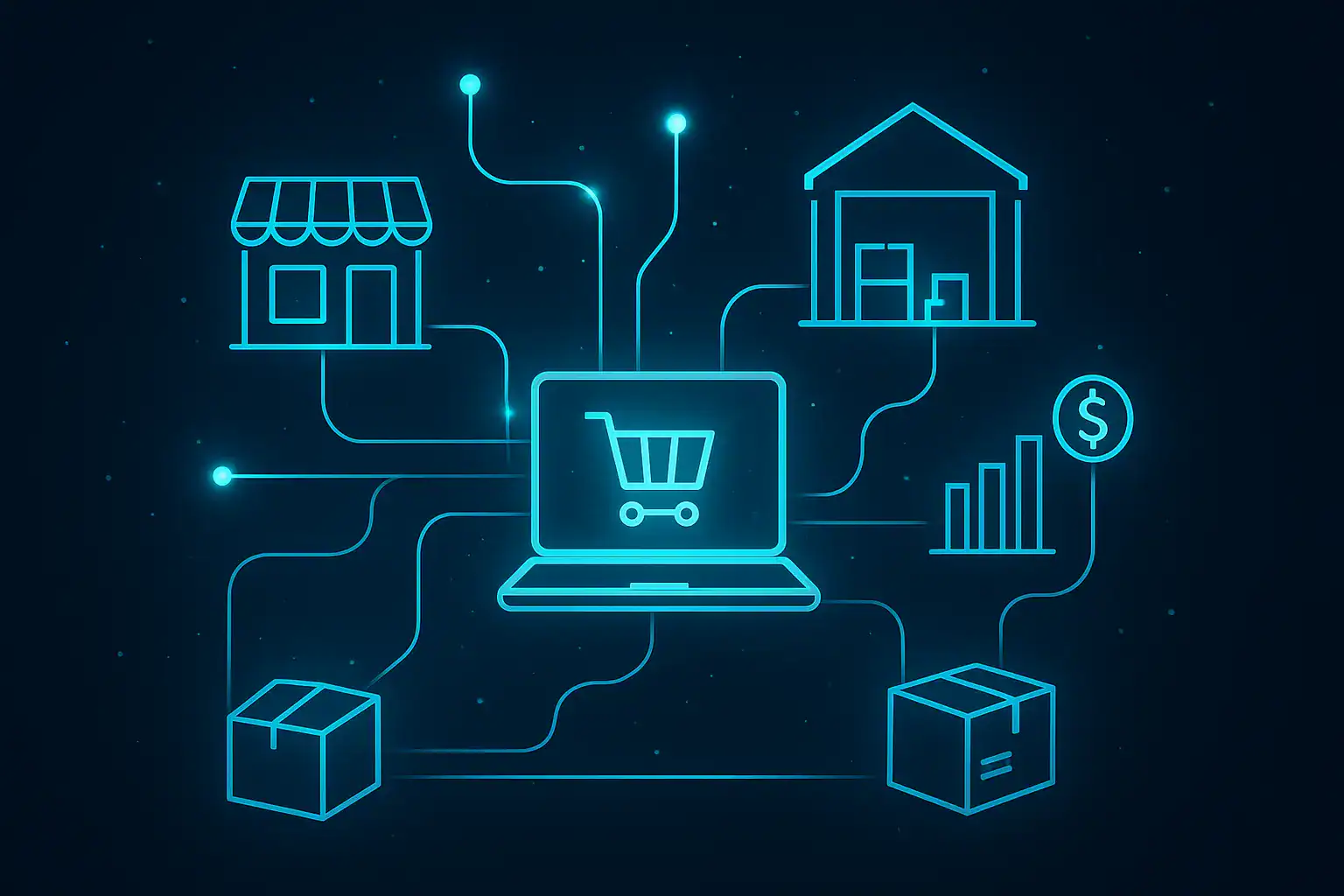
In an integrated eCommerce environment, your ERP acts as the central nervous system of your business. It communicates directly with your online store (like WooCommerce or Shopify), marketplaces (such as Amazon, eBay, or TikTok Shop), and your in-store POS systems. When properly connected, these touchpoints exchange data automatically—orders, stock levels, payments, customer information—so every part of the operation stays in sync.
For example, when a new product is added in your ERP, the system can automatically push updated product details, pricing, and inventory counts to all your sales channels. Likewise, when an order is placed, the ERP instantly reflects that sale in your financial records and adjusts inventory across all platforms.
2. A Typical Data Flow in ERP-Integrated eCommerce
To understand how ERP integration works in practice, let’s walk through a typical order lifecycle:
- Order Placement: A customer makes a purchase on your website or through a marketplace.
- Automatic Sync: The order data—items purchased, quantities, customer details, payment status—is instantly sent to the ERP.
- Inventory Update: ERP reduces the available stock in real time across every connected channel, preventing overselling.
- Fulfillment & Shipping: The ERP routes the order to the appropriate warehouse or fulfillment center, generates a pick list or shipping label, and updates shipping status once dispatched.
- Financial Recording: The system automatically records the sale, tax, and shipping cost in the accounting module.
- Customer Update: Tracking information and order confirmations are sent back to the online store and the customer automatically.
- Reporting: The transaction data is available immediately for sales, performance, and profitability analysis.
Every step is connected, eliminating manual entry, duplicate records, and delayed updates. The result is an operation that runs in real time—something impossible to achieve with disjointed systems.
3. Integration Touchpoints
ERP connects several critical areas of eCommerce operations:
- Sales Channels: Synchronizes data across WooCommerce, Shopify, Amazon, and other platforms.
- Inventory & Warehousing: Tracks stock levels, transfers, and returns across multiple locations.
- Accounting & Finance: Automates bookkeeping, reconciles payments, and provides real-time financial visibility.
- CRM & Customer Service: Gives your team a 360° view of customer orders, history, and communication.
- Procurement & Supply Chain: Links purchase orders, supplier data, and logistics for better planning.
- Analytics & Business Intelligence: Aggregates clean data for forecasting and performance measurement.
This unified structure allows the business to operate as a single entity, not a collection of disconnected tools.
4. What ERP Implementation Looks Like
Implementing an ERP system for eCommerce isn’t a single switch—it’s a phased process that ensures data accuracy and operational continuity.
- Discovery & Mapping: The integration starts with analyzing existing workflows, identifying key data sources, and mapping how information flows between systems.
- Configuration & Customization: The ERP is set up to reflect your business structure—sales channels, warehouse locations, product categories, and financial settings.
- Data Migration: Clean, structured data (products, customers, order history) is imported into the ERP.
- Integration Setup: APIs or connectors link your ERP to platforms like WooCommerce, Amazon, or POS systems.
- Testing: Each function—orders, inventory sync, accounting—is tested to ensure accurate and real-time data flow.
- Training & Rollout: Your team is trained to use the ERP daily, replacing manual processes with automated workflows.
When executed well, this process feels less like adopting new software and more like giving your business a stronger operational backbone.
5. What Happens After Integration
Once the ERP integration is live, the benefits are immediate and compounding:
- Orders flow seamlessly from multiple sales channels.
- Inventory levels are consistent and accurate everywhere.
- Financial reports and dashboards update in real time.
- Teams spend less time on manual coordination and more time on value-driven work.
- Decision-making improves because leadership finally has one clear, trusted view of operations.
Instead of firefighting daily operational issues, your business runs predictably and scales smoothly.
ERP integration is not just a technical upgrade—it’s the foundation that allows your eCommerce business to grow without losing control. With every process connected and every data point traceable, you move from reactive management to proactive growth.
The Impact of ERP Integration: What Changes After Implementation
Implementing an ERP system is rarely just a software upgrade—it’s a transformation in how your eCommerce business operates day to day. When processes, data, and teams finally work from a single source of truth, the effects ripple through every department. What once felt like daily firefighting becomes a predictable, scalable, and insight-driven operation.
1. Streamlined Daily Operations
Before ERP integration, many growing eCommerce brands rely on a mix of spreadsheets, plugins, and manual data entry. Inventory updates, order reconciliation, and end-of-month reporting consume countless hours and often require double-checking for accuracy. Once ERP is in place, these repetitive tasks are automated and synchronized across all systems.
For instance, when a sale occurs, inventory updates automatically, the financial ledger records the transaction, and the fulfillment queue is triggered—all without manual input. Instead of monitoring spreadsheets or jumping between dashboards, teams can focus on growth activities such as optimizing listings, improving product content, or enhancing marketing campaigns.
2. Real-Time Visibility and Control
ERP brings visibility that piecemeal systems simply can’t provide. Every sale, stock movement, and customer interaction is recorded in real time, giving management a live overview of performance across all channels. Warehouse staff can see which orders are pending or shipped, finance can monitor revenue and expenses as they happen, and leadership can access dashboards showing KPIs like sell-through rate, average order value, or gross margin—all from one platform.
This level of visibility reduces reliance on guesswork and delayed reports. It also helps teams make better decisions, faster—whether that means reordering a fast-selling SKU or identifying a channel that’s underperforming.
3. Scalable Growth Without Operational Chaos
One of the biggest benefits of ERP integration is scalability. Many eCommerce businesses hit a plateau when their existing tools can’t handle growing volumes. With ERP, the same operational framework that supports a few hundred orders a month can easily scale to thousands without adding proportional headcount or manual effort.
Because ERP connects every part of the business—sales, inventory, accounting, procurement—growth doesn’t break the system. Adding a new sales channel, launching a new warehouse, or expanding into a new region simply becomes a matter of configuration rather than a disruptive project.
4. Financial and Analytical Insight
With ERP, financial and operational data are always in sync. Each sale, expense, and supplier transaction is automatically recorded and reconciled, eliminating discrepancies that often arise between eCommerce platforms and accounting tools. Financial reports that once took days to compile are now available instantly, allowing leadership to understand cash flow, profitability, and cost structures in real time.
The deeper impact, however, comes from analytics. Because ERP centralizes and standardizes data, businesses can move beyond historical reporting to predictive insights. For example, by analyzing sales patterns across seasons and channels, ERP systems can forecast demand more accurately—helping procurement teams plan purchases and avoid both overstocking and stockouts. Over time, this data-driven planning strengthens margins and supports more confident business decisions.
5. Enhanced Customer Experience
Operational efficiency isn’t just an internal win—it directly improves customer satisfaction. With synchronized data and automated workflows, orders are processed faster, stock information is accurate, and fulfillment errors are minimized. Customers receive their products on time and get real-time tracking updates, while service teams have full visibility into each customer’s order history and status.
The result is fewer support tickets, faster response times, and more loyal customers. In competitive marketplaces where customer experience determines retention, these small operational advantages translate into long-term brand strength.
6. Organizational Alignment
ERP integration often brings an unexpected benefit: alignment. When everyone in the business—from warehouse staff to sales reps to executives—uses the same system and sees the same data, silos naturally break down. Teams communicate more effectively, accountability improves, and decisions are made based on facts rather than assumptions.
This cultural shift is as valuable as the operational one. ERP doesn’t just automate processes—it standardizes how the business measures success, creating a shared understanding of performance across the entire organization.
The true impact of ERP integration isn’t just efficiency—it’s control, insight, and confidence. When your systems, data, and teams are unified, growth stops being a balancing act and becomes a structured, sustainable process.
Conclusion: Scaling Without Losing Control
As your eCommerce business grows, so does its complexity. Managing multiple channels, warehouses, and customer touchpoints can quickly overwhelm a setup built on disconnected tools and manual processes. An ERP system for eCommerce solves this by bringing everything—sales, inventory, accounting, and operations—into a single, unified platform. For a detailed breakdown of a leading option, read our objective guide to Odoo for eCommerce and Retail.
With ERP integration, growth becomes structured instead of chaotic. Teams gain real-time visibility, workflows are automated, and decisions are driven by data rather than guesswork. The result is a more resilient, efficient, and scalable business.
In the end, the best ERP for eCommerce business is the one that helps you simplify operations, maintain accuracy, and grow confidently—no matter how complex your business becomes.
If cost is the objection holding you back, see what an Odoo ecommerce implementation actually costs for a realistic breakdown by engagement model. If you are weighing Odoo against a finance-led platform, our Odoo vs NetSuite comparison covers where each one actually fits.
Frequently asked questions
What is an ERP for ecommerce?
A system that centralises the operational core of an online business — inventory, orders, accounting, and customer data — so every sales channel reads from and writes to the same source of truth instead of reconciling separately after the fact.
When does an ecommerce business actually need one?
The clearest triggers are adding a second sales channel, opening a physical location alongside your online store, or serving both retail and B2B customers from the same catalogue. Revenue alone is a weak signal; operational complexity is the real one.
Is an ERP overkill for a small store?
Often, yes, if you are on one channel with straightforward fulfilment. Spreadsheets and native store tools can carry a single-channel business further than most guides suggest. The calculus changes once manual reconciliation becomes a daily task rather than a monthly one.
How much does ERP integration for ecommerce cost?
It depends heavily on how much of the configuration your own team takes on versus handing the project to an agency. See what an Odoo ecommerce implementation actually costs for a full breakdown by engagement model.
Does ERP integration replace my existing store platform?
Not necessarily. Many businesses keep their existing storefront — Shopify, WooCommerce, or otherwise — and run the ERP behind it as the operational backbone, rather than replatforming the storefront itself.
Explore Our Work & How We Can Help
- See it in action: Read our ERP-eCommerce Integration Case Study to learn how we helped a growing online brand automate its operations, sync inventory, and scale with confidence.
- Want this for your business? Our team specializes in ERP integration for eCommerce — we can help you streamline workflows, automate order processing, and scale across sales channels. Connect with us to learn more.
